
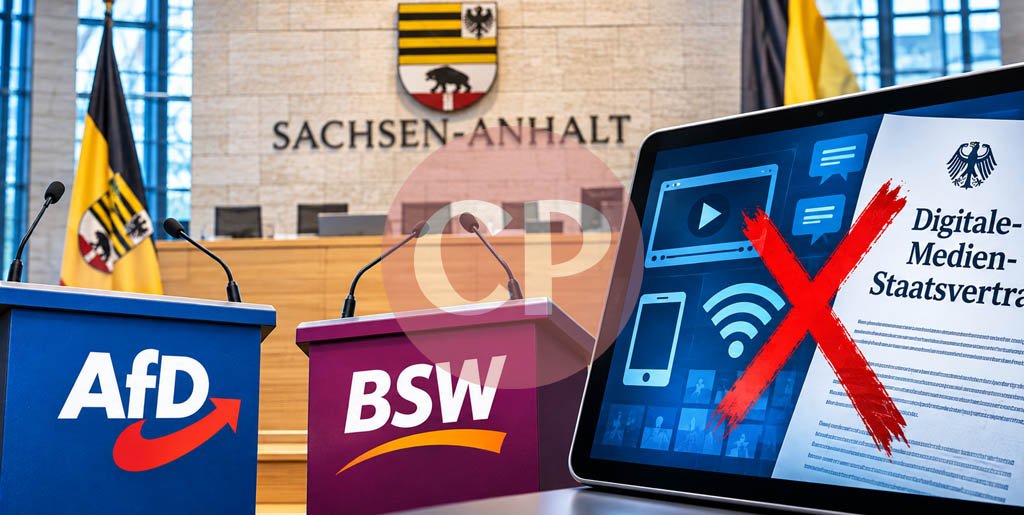

In the media committee of Saxony-Anhalt’s state parliament in Magdeburg, the far-right AfD and the populist BSW have made media policy together for the first time. Their “no” targets a treaty that all 16 German states must approve. And the deadline for terminating the treaty behind the regional public broadcaster MDR expires at the end of the year.
At its very first session on November 12, the media committee of the Saxony-Anhalt state parliament, or Landtag, adopted a statement opposing the Digital Media Treaty (Digitale-Medien-Staatsvertrag), by a vote of six to five with the votes of the AfD and the BSW (Sahra Wagenknecht Alliance). The committee sees “no basis for approving the present draft treaty,” the statement says. It also calls for further reforms of public broadcasting.
What is at stake
The Digital Media Treaty, officially the Ninth Treaty Amending the Interstate Media Treaty, is meant to implement European rules on media freedom, political advertising and media oversight, including oversight of artificial intelligence. The state premiers want to sign it by January 2027, and it is due to take effect on August 1, 2027. For that, all 16 state parliaments must approve it. If Saxony-Anhalt says no, the treaty is blocked nationwide.
The CDU-led state government, still in office as a caretaker, is not bound by the committee’s statement. That could soon change: in the state election on September 6, the AfD won 43.8% of the vote. We described the possible consequences for public broadcasting at the time. Since October 6, with Tobias Rausch, the AfD has held the presidency of a German state parliament for the first time. The party’s lead candidate, Ulrich Siegmund, wants to be elected state premier in mid-December.
The reactions
Daniel Sturm, the CDU’s media policy spokesman, said the draft was the wrong vehicle for a fundamental debate about broadcasting, and that rejecting it would expose Saxony-Anhalt to EU infringement proceedings. Eva von Angern, who leads the Left Party’s parliamentary group, warned of “draconian fines” that would burden the state budget. Social Democrat Armin Willingmann accused the AfD and the BSW of preparing the state’s exit from public broadcasting. Michael Reim, the BSW’s media policy spokesman, sees a “considerable need for reform,” saying public broadcasting must become more diverse and more transparent.
The year-end deadline
Siegmund has announced that terminating the broadcasting treaties will be one of his first acts in office. The MDR treaty can be terminated at the end of any year with two years’ notice. A termination by December 31, 2026, would take effect at the end of 2028. It would require the approval of the state parliament. Dieter Dörr, a media law scholar in Mainz, considers a termination possible in principle. But the state would then have to create its own media framework that neither starves public broadcasting nor reduces it to a bare-bones “basic service,” he said. Whether the terminations would be legally effective is unclear.
The other states are looking for a way out. The conference of state premiers plans to discuss abandoning the unanimity rule for interstate treaties on December 10, before Siegmund could take office.
Analysis
Criticism of public broadcasting is legitimate, and many see a need for reform, not just the AfD and the BSW. But the “no” from Magdeburg targets, of all things, a treaty that implements EU rules on media freedom, including the European Media Freedom Act. That law obliges states to protect newsrooms from political interference. Anyone who blocks it to put pressure on the public broadcasters ARD and ZDF is accepting that this protection will take longer to arrive.
The other states’ response comes at a price, too. Until now, the unanimity rule has protected Germany’s broadcasting framework from being overhauled in one stroke by a simple majority. Abolishing it out of concern about one state changes the rules for everyone. Public broadcasting whose foundations shift with each election result can hardly do its job: reporting independently, including on those who happen to be in power. Whether citizens learn what is really happening in their country depends on it.
Sources