
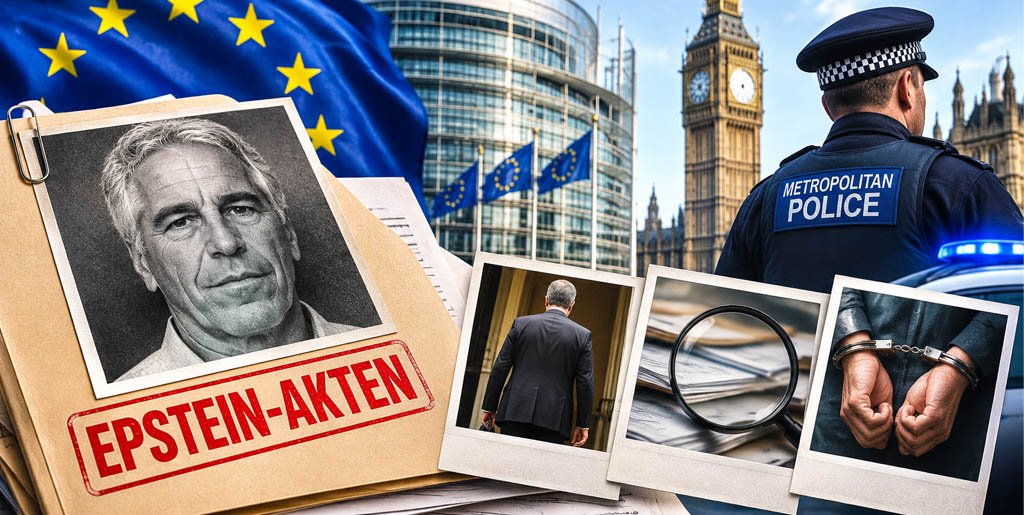

In the United States, the fallout from the published Epstein documents has so far been limited. In Europe, diplomats, politicians and aristocrats are falling. On Monday, former British ambassador Peter Mandelson was arrested, four days after Andrew Mountbatten-Windsor. An overview and an analysis.
The arrest. On Monday, February 23, London police arrested Peter Mandelson, the former Labour minister, former EU trade commissioner and, until September 2025, British ambassador in Washington. He was arrested on suspicion of misconduct in public office. Investigators are looking into the suspicion that, as business secretary, Mandelson passed confidential, market-sensitive government information to Jeffrey Epstein, for example in 2009. There are no allegations of sexual misconduct against him. Police had previously searched two addresses in Wiltshire and in the London district of Camden. He was released on bail overnight, and the investigation is continuing. His lawyers said he had been arrested even though a voluntary interview with police had been agreed for March. Mandelson denies any wrongdoing and is presumed innocent.
Where the new information comes from. On January 30, the U.S. Justice Department released another large batch of the Epstein files, about 3 million pages. They include emails showing Mandelson’s closeness to Epstein even after Epstein’s 2008 conviction. Prime Minister Keir Starmer had already recalled him as ambassador in September 2025, after Bloomberg published emails. In early February, Mandelson left the Labour Party and stepped down from the House of Lords. The government handed documents to the police. Starmer apologized to Epstein’s victims and accused Mandelson of lying during the security vetting for the ambassador’s post. His chief of staff, Morgan McSweeney, whom several Labour lawmakers blamed for the appointment, resigned on February 8.
Europe, not America. The files have had consequences in several European countries:
- Britain: In addition to Mandelson, Andrew Mountbatten-Windsor, the former Prince Andrew, was arrested on February 19 on suspicion of misconduct in public office; he was released after about 11 hours, and the investigation continues.
- Norway: Crown Princess Mette-Marit acknowledged her ties to Epstein and apologized publicly. Ambassador Mona Juul, the wife of diplomat Terje Rød-Larsen, resigned after it emerged that Epstein had left the couple’s children $10 million in his will. The economic crime unit Økokrim is investigating former prime minister and Council of Europe Secretary General Thorbjørn Jagland for aggravated corruption; the Council of Europe lifted his immunity for that purpose. Jagland denies the allegations; his lawyer said he would cooperate.
- Slovakia: Former foreign minister and EU special representative for the Western Balkans Miroslav Lajčák resigned as security adviser to Prime Minister Robert Fico; he denies any wrongdoing.
- Sweden: Joanna Rubinstein resigned as chair of Sweden for UNHCR after her 2012 visit to Epstein’s island became known.
- Poland: Prime Minister Donald Tusk has tasked a team with searching the files for Polish victims and for links between Epstein and Russian intelligence.
In the U.S., by contrast, the releases have so far had hardly any serious consequences for Epstein’s acquaintances.
Analysis
First: No disclosure, no accountability. The consequences in Europe exist because documents became public and journalists analyzed them. The release of the files was fought over in the U.S. for years. Without investigative reporting, victims’ lawyers and public pressure, many of these papers would still be sitting in an archive.
Second: Not every mention is an accusation. The files contain names, emails and appointments. Appearing in them does not automatically mean someone committed a crime. With so much material, newsrooms bear a particular responsibility: to distinguish between acquaintance, poor judgment and crime, and to give everyone concerned the chance to respond. The presumption of innocence also applies in the glare of publicity.
Third: This is about power, not just morality. The Mandelson case shows what is at the core: whether powerful people pass confidential government information to private friends, and whether governments look closely enough when making appointments. Such questions concern every citizen, because they determine whether the state’s knowledge serves the public good or private interests.
Fourth: Europe should not become complacent. That consequences follow faster here than in the U.S. speaks for functioning oversight. But in Europe, too, that oversight depends on a press that can report freely, on authorities that release documents and on courts that are independent. Where any of these is missing, the files stay closed.
Sources
- ZDFheute: Mandelson nach Festnahme auf Kaution frei (February 23, 2026)
- Der Standard: Mandelson festgenommen (February 23, 2026)
- AP/Ahram: Police in Britain arrest Peter Mandelson (February 23, 2026)
- AP/PBS: New revelations from Epstein files take a toll across Europe (February 11, 2026)
- AP/ABC: Epstein revelations have toppled top figures in Europe (February 7, 2026)
- AP/Ahram: Epstein files lead to resignation in Slovakia (February 1, 2026)
- Anadolu: Swedish UN official resigns (February 2, 2026)
- Euronews: Chief of staff quits over Mandelson scandal (February 9, 2026)
- Al Jazeera: Norwegian police search Jagland’s properties (February 12, 2026)
- Irish Times: Mandelson freed on bail (February 23, 2026)
- Dawn/AFP: UK police arrest ex-envoy Mandelson (February 23, 2026)