
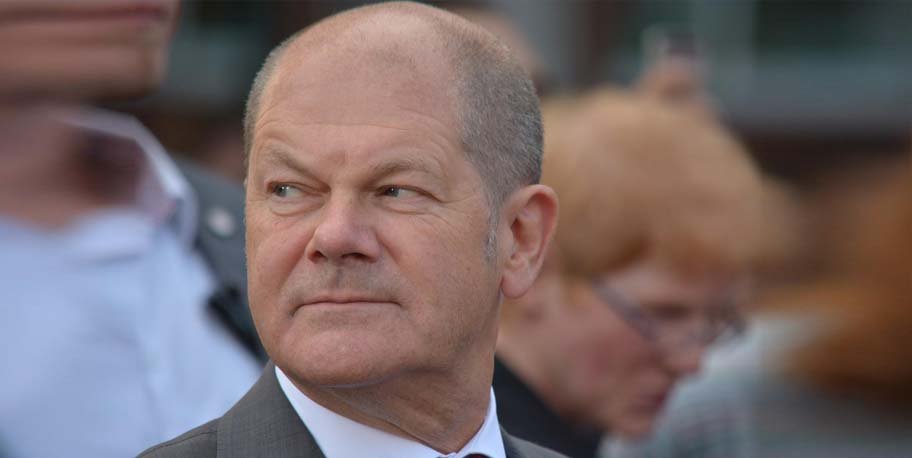

Berlin. “Good day, I’m glad we can all be here together and have a discussion. That is part of our democracy,” Chancellor Olaf Scholz said as he welcomed some 150 guests to the Festung Mark in Magdeburg for the second “KanzlerGESPRÄCH,” his town hall-style conversation with citizens. Talking is still the best way to tackle the questions of the future “that concern people, and the worries we all have,” the chancellor said.
Asked in the first question of the evening what he associates with Saxony-Anhalt, Scholz replied: “The river that connects everything, the Elbe. Coming from Hamburg, that is something special for me too.”
|
What the chancellor said…
… on further relief
Kristin Musche from Magdeburg wanted to know how the chancellor intends to stop rising inflation. The young mother is currently on parental leave and is wondering whether she will have to go back to work full time. Scholz replied: “We said we would not leave citizens on their own and started very early to introduce relief measures. There are so many that nobody can remember them all.”
They include the 9-euro ticket, the three-month fuel discount at gas stations, the abolition of the EEG surcharge for renewable energy, the monthly immediate child supplement, the one-off child bonus, the one-off payment for people on basic income support, the heating cost subsidy, the energy price allowance for employees subject to income tax, the cut in sales tax on gas, and the increase in the employee allowance and the commuter allowance.
“And what I want to assure you now,” the chancellor said, “is that it won’t stop at what I have just listed. We are working hard to launch a third relief package. Because nobody can simply shoulder this, except those who really have a lot of money. But that is not most people in our country.”
… on support for retirees
The situation of retirees will also be looked at closely, he said. Asked by a retiree where his group stood in the relief measures, the chancellor said: “With the third relief package, we also want to check: have we considered everyone, and who else needs to be taken into account?” In addition, a major reform of housing benefit is planned, which will also expand the group of people entitled to it. “We are currently calculating exactly how that will work and how best to do it, so that there is not only support but also many more people benefiting from it than is the case today, because that is fair,” Scholz said.
… on the war in Ukraine
Michael Fischer from Magdeburg was worried and asked whether supplying weapons to Ukraine would gradually increase the risk of war for us too. The chancellor assured him that Germany would continue to act with prudence and careful consideration: “Because in everything we do, our goal is to support Ukraine but to prevent an escalation of the war into one that is no longer between Russia and Ukraine but would be a completely different war. And you can rely on us to always have the prudence, the clarity and the firmness to decide according to this principle.”
… on energy supplies
One participant was also worried about gas supplies and the situation of small businesses. Scholz replied: “Of course we are also making sure that businesses survive, that jobs are preserved and that we get through this period, not only with the relief measures we have already talked about but also by introducing support measures for companies.”
In addition, Germany had prepared very early, back in December, for the question: what actually happens if we no longer get any gas? “We then got to work on it. And when the war started, we had already found out a great deal and were in a position to make decisions. For example, we decided to build pipelines to the northern German coast at breakneck speed, with many changes to the law, and to build terminals so that we, like most countries in the world, can receive gas by ship.”
A number of other measures were also decided, such as filling the gas storage facilities: “We are already at over 80 percent and want to reach 85 and 95 percent. We said we would switch back on the coal-fired power plants that had already been shut down but are ready to operate, and we will also use lignite for a little longer. We are even examining whether it makes any sense for the three remaining nuclear power plants to use up a little of the remaining capacity they have.” With all this help and these measures, Scholz said he hoped we would get through the winter well.
… on sanctions against Russia
“Can we afford to do without trade with Russia?” another participant asked during the KanzlerGESPRÄCH. “We did not decide on these sanctions, together with many others, because we had always wanted to; it was terribly hard for us. But our line is: we support Ukraine so that it can defend itself. We want to prevent an escalation of the war.” That includes using the effective instrument we have to convince Russia that it cannot go on like this, he said.
“The sanctions are very, very effective,” Scholz said. No country in the world has a future if it is cut off from economic and technological progress. “And if a country like Russia, which does not have many companies and technologies as advanced as ours, can no longer take part in that, then that is very dramatic. And it is meant to help bring the war to an end.”
… on the future of buses and trains
A young man from Magdeburg asked the chancellor: what is the future of the 9-euro ticket, and of rail as a whole? The chancellor said that since many citizens had used the 9-euro ticket and felt it was a great improvement, the government wanted to develop something new from it. “Transport Minister Wissing is working on how we can develop something with the states and municipalities that means we don’t continue the 9-euro ticket, but something that is attractive in this way and uses the advantages and the lessons we have learned from it,” Scholz said.
On the future of buses and trains, the chancellor said this involves a lot of long-term investment. “But we want to do it by spending more money on rail transport in Germany and making sure that traveling by train becomes more attractive.”
… on legalizing cannabis
Karsten-William Müller, 20, from Magdeburg wanted to know when cannabis legalization is planned. The chancellor had a clear answer: “In this legislative term.” He readily admitted that it had taken him a while to come round to the idea: “Because, first, I have never smoked weed, and second, of course I think all drugs cause problems,” with consequences for one’s own health. “But we said: times are changing, and that is why we will do it. And it should happen fairly quickly.”
Participants chosen by lot
The roughly 150 participants from Magdeburg and the surrounding region decided for themselves which topics and questions they wanted to discuss with the chancellor. They were selected through an independent lottery carried out at the University of Magdeburg. All citizens aged 16 and over could take part.
“It was a good, very intelligent discussion”
At the “meet and greet” afterward, participants had the chance to take a souvenir photo with the chancellor. “It was a good, very intelligent discussion. It was a nice evening for me too,” Olaf Scholz said after his second KanzlerGESPRÄCH.