
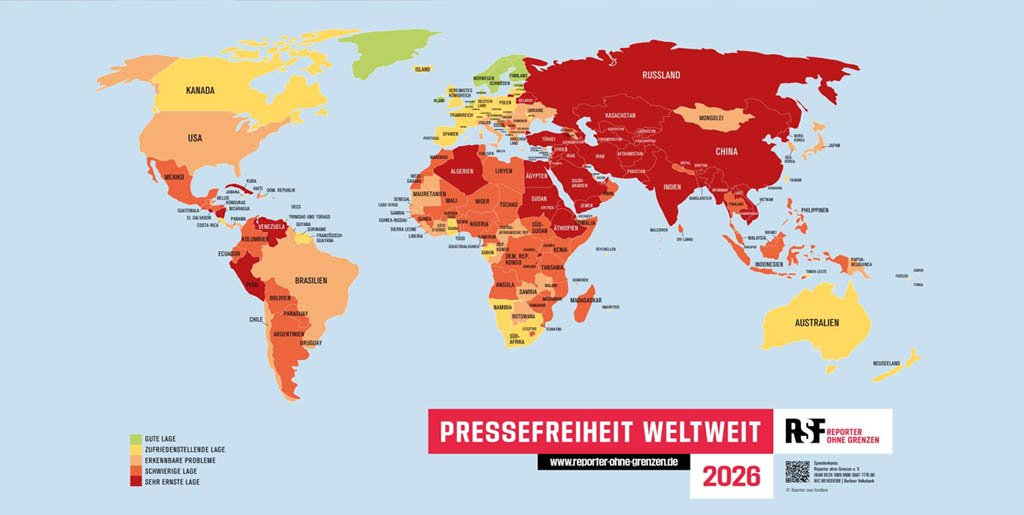

Reporters Without Borders finds press freedom worldwide weaker than at any time since the index began. In more than half of all countries, the situation is difficult or very serious. The two countries we cover most closely are also losing ground significantly.
Report
Press freedom worldwide is at its lowest level in 25 years. That is the finding of the 2026 index published today by Reporters Without Borders (RSF). For the first time, more than half of the 180 countries assessed, 94 or 52.2%, fall into the two worst categories, “difficult” and “very serious.” Only seven countries, all in Northern Europe, are still rated “good”; only about 1% of the world’s population lives in them.
The legal indicator deteriorated the most: in 110 of 180 countries, more than 60%, the legal situation for press freedom worsened between 2025 and 2026. National security and counterterrorism laws are increasingly being used against journalists, including in democracies, RSF says, along with intimidation lawsuits. The case of Alican Uludağ, Turkey correspondent for Germany’s international broadcaster Deutsche Welle, also shows how journalism is being criminalized: he has been in custody since February 20, charged with insulting the president and spreading misleading information.
Italy falls from 49th to 56th place. That makes Italy the lowest-ranked of the large European countries, said Pavol Szalai, head of RSF’s EU and Balkans desk. RSF cites threats from mafia organizations, especially in the south, violence by extremist groups and the frequent intimidation lawsuits against journalists. The journalists’ union FNSI speaks of a situation of “great suffering” for press freedom.
Germany slips three places to 14th. RSF points to a harsher working climate, online hate and threats, and a loss of trust in the media. On the legal framework alone, Germany would rank 11th.
Analysis
Two figures deserve particular attention. The first is the legal indicator: press freedom is increasingly being restricted not by violence but by statutes, through secrecy rules, publication bans and lawsuits. That also applies to the EU. In a few days, on May 7, the deadline expires by which all member states must have implemented the anti-SLAPP directive against intimidation lawsuits.
The second is Italy’s decline. Seven places in a year is no statistical fluke. It reflects a trend we have been reporting on since 2024: the ban on publishing arrest warrants, spyware used against journalists in the Paragon case, the bomb attack on “Report” host Sigfrido Ranucci.
Rankings are not verdicts, but they are early warning systems. Those who ignore them only notice the loss of press freedom when it affects their own freedom: when the information they would have needed for a decision is missing, or when no one reports anymore on what is happening on their own doorstep.
Sources
- ZDFheute: Deutschland rutscht bei Pressefreiheit weiter ab (April 30, 2026)
- Il Fatto Quotidiano: L’Italia sprofonda al 56° posto (April 30, 2026)
- RSF Switzerland: 2026 Index press release (PDF)
- netzpolitik.org: Niedergang der Pressefreiheit setzt sich dramatisch fort
- RSF: 2026 RSF Index, press freedom at a 25-year low (April 30, 2026)
- L’AltraMontagna/il Dolomiti: Intervista a Pavol Szalai (RSF) (April 30, 2026)
- ZDFheute: Deutsche-Welle-Journalist in der Türkei festgenommen (February 20, 2026)