
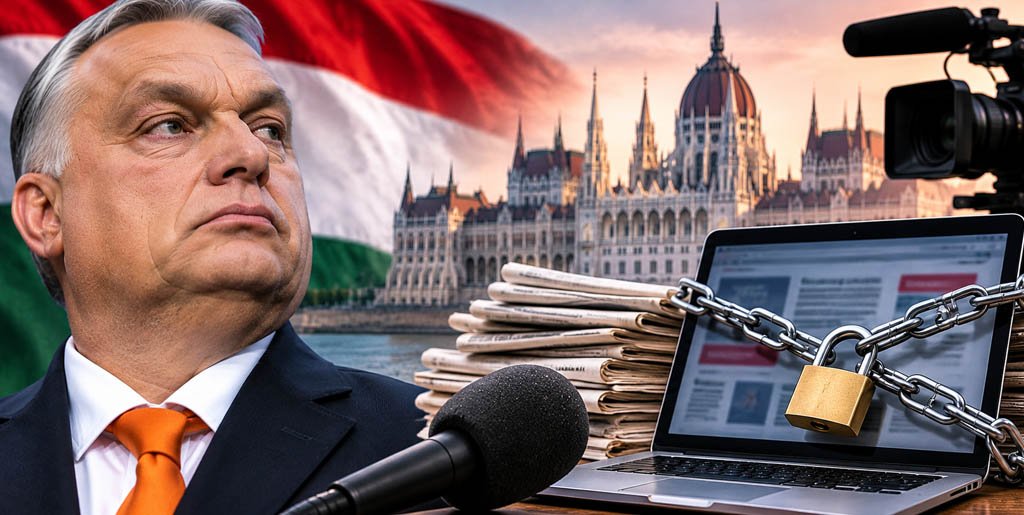

For 16 years, Viktor Orbán reshaped Hungary’s media landscape to his liking. After his election defeat, his successor Péter Magyar is promising independent media. Whether that leads to press freedom or merely to a change of propaganda is the most important question of the coming months.
The election. On April 12, the opposition party Tisza, led by Péter Magyar, won Hungary’s parliamentary election with a two-thirds majority, on a record turnout of almost 80%. Orbán conceded defeat on election night. According to the official final result, released almost a week later, Tisza won 141 of the 199 seats. The new parliament must convene by May 12 at the latest; Magyar, himself a former member of Orbán’s Fidesz party, is then due to be sworn in as prime minister in May. With a two-thirds majority, his government can also amend laws with constitutional status, including the media law.
The Orbán system. Since 2010, Orbán brought the media sector under his control step by step. The 2010 media law created a central holding company for all state broadcasters and agencies, MTVA, formally a public broadcaster with a mandate for balanced reporting. In practice, its news became a mouthpiece for the government: Orbán appeared on state-run Radio Kossuth every week, opposition politicians were rarely invited, and coverage of critics such as Magyar was almost entirely negative. Numerous private outlets were shut down or taken over by businessmen close to the government. In November 2018, owners close to Orbán transferred 476 media outlets, including all regional newspapers, free of charge to a foundation called KESMA. For years, state advertising has flowed mainly to friendly outlets.
What Magyar is announcing. On April 15, in interviews with state-run Radio Kossuth and the news channel M1, Magyar announced the overhaul. It was his first appearance on state media since September 2024. One of the first steps after the government is formed, he said, would be to suspend MTVA’s news programs until their objectivity is guaranteed. When the M1 anchor objected that this would violate the law, Magyar replied that the broadcaster itself had failed to meet its obligations under the media law. In a Facebook post, he wrote that the staff had worked under total intimidation and political terror. He promises a new media law and a new media regulator. He also called on President Tamás Sulyok to resign after the new government takes office; otherwise, the new majority would seek his removal.
Analysis: The opportunity and the risk
The opportunity. For years, Hungary was the example of how a free press can be systematically hollowed out within the EU, not with arrests but with money, ownership and laws. A change of government opens up the chance to dismantle that system: a truly independent media regulator, fair allocation of state advertising, transparent ownership structures. The European Media Freedom Act, in force since August 2025, provides the framework. The organizations of the Media Freedom Rapid Response (MFRR), including IPI, called on April 15 for parliament to set up an independent expert group for the media reform.
The risk. Even an overhaul meant to end propaganda is a government intervention in the media. When a new majority suspends a broadcaster’s news and replaces its management, it looks to tomorrow’s opposition exactly like yesterday’s power grab. The independence of public media is proven not by who controls them but by the fact that no one does. What will matter is whether Magyar creates procedures that bind him too: transparent selection of management, judicial oversight and funding that does not depend on the government’s goodwill.
The lesson for Europe. The Hungarian case shows how long it takes for a captured media landscape to have consequences, and how hard it is to win it back. For 16 years, voters cast their ballots in a country where many heard only the government’s point of view. That they nevertheless voted for change is also thanks to independent online media and investigative centers that kept working under the most difficult conditions.
What it means for the individual. Elections are only as free as the information on which people vote. A media landscape that serves only one side deprives citizens of the ability to form their own judgment, long before they go to the polls. That is why rebuilding free media in Hungary is not just a Hungarian matter. It is a test of whether Europe learns from its mistakes.
Sources
- bpb: Parlamentswahl in Ungarn (April 15, 2026)
- Euronews: Orbán gesteht Niederlage ein (April 12, 2026)
- ZDFheute: Magyar räumt auf – Ungarns Medienlandschaft wird umgekrempelt (April 15, 2026)
- Al Jazeera: Magyar urges president to quit, vows to overhaul state media (April 15, 2026)
- CEETV: Magyar vows to suspend state media news output (April 15, 2026)
- IPI/MFRR: Media freedom reform must be priority for incoming Tisza government (April 15, 2026)
- blue News/dpa: Zweidrittelmehrheit für Tisza gesichert (April 18, 2026)
- Schwäbische/dpa: Magyar will staatliche Nachrichtensendungen stoppen (April 15, 2026)
- Átlátszó: How the pro-government media empire owning 476 outlets was formed (November 30, 2018)