
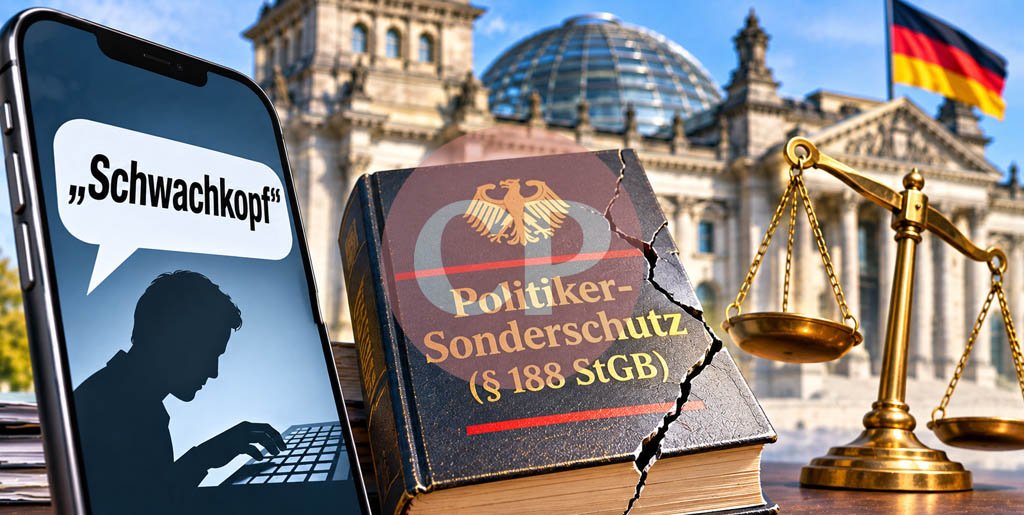

A year and a half after a police search of a home in Lower Franconia, the German law on insulting politicians is up for debate. The state justice ministers want to sharply restrict it, and the chancellor is open to change. For freedom of expression, that is good news, but it is not yet a reform.
In November 2024, police rang the doorbell of a 64-year-old retiree in the district of Haßberge early in the morning. He had shared an image showing then-Economy Minister Robert Habeck as a “Schwachkopf PROFESSIONAL” (“moron PROFESSIONAL”). We explained at the time what Section 188 of the German Criminal Code covers and why it is controversial. Since then, the individual case has become a debate over principle.
What became of the case
In the end, the man was not charged over the meme. In June 2025, the district court in Haßfurt fined him €825, but for other posts: the court was convinced he had shared images bearing symbols of unconstitutional organizations. The charge of incitement to hatred was dropped. The ruling is not final.
New cases, new pressure
Other cases have since come to light, many over remarks about Chancellor Friedrich Merz. Over “Pinocchio,” prosecutors dropped the case for lack of sufficient suspicion. Over “Lackaffe” (“stuck-up fop”), a case in Heilbronn was dropped in exchange for a payment. A Facebook user who had called Merz “Lügenfritz” (“lying Fritz”) received a penalty order. This is possible because, under Section 188, prosecutors can investigate even without a complaint from the person concerned if they see a special public interest.
What politicians want now
Jens Spahn, who leads the CDU/CSU group in the Bundestag, called back in January for Section 188 to be abolished, saying the general offense of insult was sufficient. On January 29, a bill from the AfD to delete the provision failed in the Bundestag by 133 votes to 440. Parliament held a first reading of a new AfD bill on June 11 and referred it to committee.
The states are giving the debate real weight. Meeting in Hamburg from June 10 to 12, the conference of state justice ministers, at the request of Saxony and Baden-Württemberg, called for a fundamental reform: the special protection in Section 188(1) would no longer apply to top politicians, only to local officeholders and elected officials. Saxony’s justice minister, Constanze Geiert (CDU), had earlier even floated abolishing it entirely.
Over the weekend, Merz also said he was open to discussing a reform. As chancellor, he said, he had not filed a criminal complaint. He draws the line where it is not the person but the office that is damaged: “The moment the offices of state are damaged, that’s where the fun stops for me.”
Analysis
The justice ministers’ proposal would take the provision back to the purpose for which it was expanded in 2021: protecting mayors and local councillors from hate campaigns that drive people out of office. Chancellors, ministers and party leaders do not need that special protection. For decades, Germany’s Federal Constitutional Court has stressed that the powerful in particular must tolerate sharp and polemical criticism. Against genuine insults, Section 185 remains available to them as to everyone else.
Nothing has been decided yet, however. The justice ministers’ conference can only make recommendations; it is up to the Bundestag to change the law. Until then, a situation persists that harms freedom of expression: anyone who mocks a head of government must expect an investigation, even if that person never complains. This affects not only citizens on social media but also satire and commentary, core areas of press freedom. A democracy is measured by how much mockery its leaders can bear, not by how well they are shielded from it.
Sources
- Berliner Zeitung, June 2025 (Haßfurt ruling)
- LTO, June 3, 2026 (Saxony, “Pinocchio”)
- LTO (“Lackaffe”)
- beck-aktuell, June 9, 2026 (“Lügenfritz”)
- Bundestag, document 21/6328 (Spahn)
- Bundestag, January 29, 2026 (vote on 21/652)
- Bundestag, June 11, 2026 (first reading of 21/6328)
- Baden-Württemberg Justice Ministry, June 2026 (justice ministers’ conference)
- Schwäbische/dpa, June 21, 2026 (Merz)