

Key points
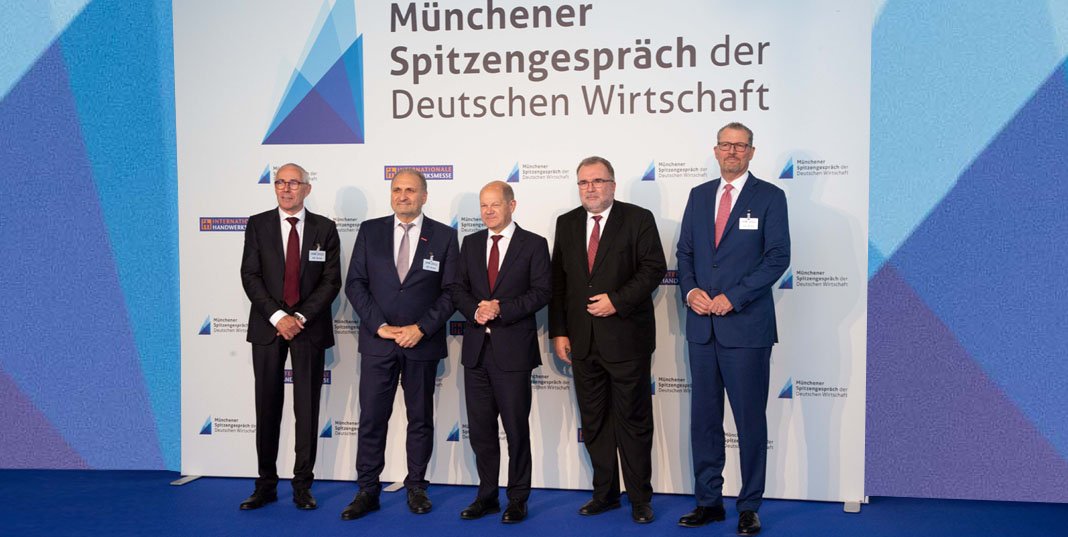
- On July 8, 2022, Chancellor Olaf Scholz met Hans Peter Wollseifer, president of the German Confederation of Skilled Crafts (ZDH), at the traditional top-level business meeting in Munich.
- Wollseifer named faster planning and approval procedures and the shortage of skilled workers in the trades as the most pressing issues.
- Scholz pointed to preparations for possible gas shortages: new liquefied natural gas terminals, pipelines and rules for filling gas storage facilities; coal and oil imports from Russia were to be replaced by the end of the year.
- He was also asked about aid for the gas importer Uniper.
Transcript
The following transcript was published by the German government.
Munich. Wollseifer: Ladies and gentlemen! I believe talking with the chancellor has never been as important as it is now. This is a time when only business and politics together can cope with the tasks, problems and challenges ahead.
In our conversation, we had a number of topics and a number of questions that were weighing on us. We talked about the future competitiveness and also the resilience of the economy. Other things weighing on us were planning and approval procedures, which we need to speed up significantly, and of course the issue that concerns the skilled trades in particular, namely the shortage of skilled workers. The chancellor answered the questions in great depth. We also arrived at one or two solutions. Chancellor, perhaps you can explain.
Chancellor Scholz: Thank you very much for the opportunity to join the Munich top-level meeting. This is a long tradition in our country.
Indeed: we have come together at a very special moment in our history. Russia’s war of aggression against Ukraine has changed a great deal and has endangered peace in Europe, with one country attacking its neighbor and trying to conquer part of its territory, or perhaps the whole country. That is something we had agreed should never happen again in our world. That it is happening anyway endangers peace. As we know, this has dramatic consequences around the world, but also here at home.
That is why it is important that we deal with the challenges that arise from it. One of them is energy security. We have taken many very far-reaching decisions to prepare for the possibility that energy supplies could become scarce. We started doing this even before the war, because the danger was foreseeable. That applies to the question: can we organize our coal and oil supplies without Russian imports? Both are possible and are targeted for the fall and the end of the year, so we have created the conditions for that.
As far as gas is concerned, we deliberately did not impose sanctions, but said: alongside the imports that are still necessary in many European countries and in Germany too, we will make sure that we build infrastructure that allows us to import gas from all over the world, with liquefied natural gas terminals on the northern German coast and with pipelines that are being built. That is now under way. We will try to get these things done at a pace never seen before.
We have issued rules that mean we are putting gas into storage, much more than in previous years. We are also already much further along than in previous years and will continue to do so. We have made sure that power plants that use coal are now being used again so that we save gas this year. All of this together, along with everything else we are doing, is meant to help us guarantee energy security.
But it is also a sign that we have to do a great deal to bring about the major transformation that will modernize our economy. Energy production plays a central role in this. Our goal is to be CO2-neutral by 2045. That means we have to use offshore and onshore wind power, solar energy and all the other options, including biogas and others, to ensure that we have a CO2-neutral economy. Many economic and industrial processes also have to change. They will then need even more electricity from renewable sources than we produce today.
We want to achieve this ambitious goal, just as we are now quickly building new terminals on the northern German coast, by changing all the laws necessary so that all of this can be built and created at the greatest possible speed. Just this week, the Bundestag passed more of the laws needed for this. We will carry on like this. My goal is that we will not let ourselves be discouraged. We will not need two years for these acceleration laws; we will get everything under way this year so that it actually happens. Our ambitious goals can only be achieved at the greatest possible speed.
That is also the question we discussed very carefully here. Speed is what matters on these issues, but also in many other approval processes. I gave my assurance that we will do this.
We are at a skilled trades fair here. So I want to say once again that it is my firm conviction that Germany’s skilled trades are of the utmost importance for the future of our country. Everything we have set out to do, the housing to be built, the building renovations now needed, the renewable energy installations to be put up, the power lines we need to get electricity from one corner of the country to the other, requires skilled trades, qualified tradespeople with the highest professional standards.
At the same time, the skilled trades are not only a traditional sector of our economy but also one of the most innovative. Just walking around the fair here and seeing some of the exhibits shows that it is always about great progress as well. Technological progress happens at our big, world-famous companies, but also in Germany’s skilled trades. That all of this comes together is a good thing.
One last remark: of course we also talked about rising prices. That is a big challenge for many citizens who have no savings, but also for many companies. Many of them, too, have no reserves to cope with sudden, dramatic price increases for raw materials, supplies and energy.
That is why I want to say to everyone: it will not stop at the two packages worth almost €30 billion that we have introduced to provide relief for citizens and businesses. We will continue, and that is why we have launched the “Concerted Action,” as worked once before in the 1970s, so that we can discuss together how we can make sure that we all get through this period well and safely.
That we could discuss this here together and take a look at Germany’s innovative traditional trades is a good thing. I am glad to be here today.
Question: Hello, Mr. Scholz! When you talk to tradespeople at the fair and to many businesses, you find that they are of course worried about the fall and whether there will still be enough gas then. There is some fear of competition between industry and the trades: who will get the gas? How can such competition be prevented?
Chancellor Scholz: As I just said, we began preparing for this when I became chancellor. In December, I brought together the economy minister, the Federal Network Agency and others and began talking with them: what do we actually do if we run into shortages? That was good, because when the war began, we were able to get going, since we had already thought everything through. For example, we were able to order ships right away to transport liquefied natural gas, which can be converted back into gas and then carried on through our pipelines. We were able to decide to build these pipelines. We were able to introduce laws under which this is now happening at great speed. We passed laws on gas storage. We have spent billions in public money to make sure the storage facilities are full, and we are continuing to do so. We have passed laws that now allow us to use coal instead of gas. We will continue along this path.
We are also preparing for what can be done in a shortage. We are trying to identify companies that would voluntarily use less, with incentives we give them for doing so, so that others can then carry on their business unhindered. For many businesses, this can also be the point at which they invest very quickly and concretely in energy-saving technology, helping themselves and many others. That is part of our solution.
I also want to say: we are also working to make sure it does not come to that. As you have seen, we have begun good talks with the Canadian government, which I already started very carefully in Elmau, so that we can ensure that all the conditions are in place so that there are at least no good reasons for the gas transit not to take place.
Question: Chancellor, what is the government planning to do to help Uniper?
Chancellor Scholz: We have in any case taken the political decision that we will help Uniper. The company can rely on that, its workforce can rely on it, and so can everyone in Germany who knows that this is a company of great importance for supplying large parts of the economy and many consumers. We will discuss the specific approach with the company. We have been doing so for a long time. That is now being stepped up again. Everyone can be sure: we will do our part to save Uniper.
Question: Mr. Scholz, there was a lot of talk at the fair about the shortage of skilled workers and the need for a change in education. What do you think about possibly enshrining in law the equivalence of vocational and academic education?
Chancellor Scholz: I think what is needed above all is a change in mindset. Vocational training, an apprenticeship in a skilled trade, perhaps a master craftsman’s qualification on top of that, is equivalent to a university degree. It is also a good path in life with good prospects, good earning potential and a lot of job satisfaction. The professionalism that so distinguishes Germany, the fact that we are proud of what we achieve and want to do it well, is a tradition that comes from Germany’s skilled trades and has shaped our way of life far beyond the trades.
That is why I think we must do everything we can to ensure that young people choose a career in the skilled trades after ninth and tenth grade, and sometimes after the Abitur, Germany’s university entrance qualification. This also has to do with making it possible, above all long before the end of school, to gain experience of the many professions and the attractive opportunities for self-fulfillment in Germany’s skilled trades. That will be a task to which the whole government will devote itself, together with the states and everyone working in schools. I am sure the skilled trades have a good future. Anyone who chooses training in a skilled trade and wants to pursue a career there is doing everything right.