
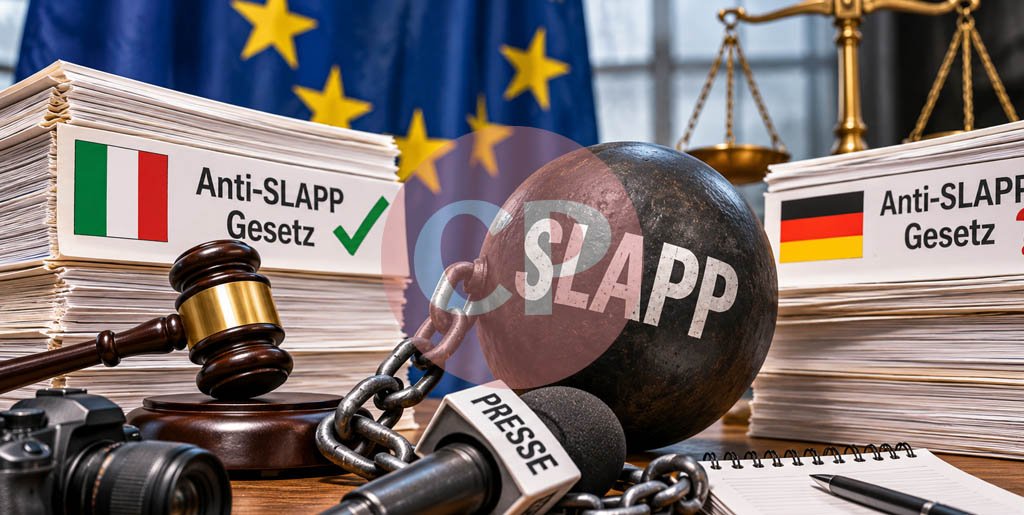

Italy’s law against intimidation lawsuits takes effect today, six months after the EU deadline. In Germany, the bill is still before the Bundestag. Both countries go only as far as Brussels strictly requires, and leave most cases out.
Italy’s Legislative Decree No. 194 of October 8, 2026, took effect on November 8. It implements EU Directive 2024/1069, also known as “Daphne’s Law” after the Maltese journalist Daphne Caruana Galizia, who was murdered in 2017. The deadline for doing so expired on May 7. In July, the European Commission therefore opened infringement proceedings against 14 countries, including Italy and Germany. In September, we reported on what the Italian draft looked like. The final text largely matches it.
What the Italian law provides
Anyone sued over their public participation, meaning journalists, publishers, whistleblowers, activists, NGOs, unions or academics, can now ask for a manifestly unfounded lawsuit to be dismissed at an early stage. The court can require the plaintiff to provide security for costs and damages. If it finds the proceedings abusive, it can order the plaintiff to make an additional payment even without a request, and order the judgment to be published. Withdrawing a lawsuit does not let the plaintiff escape the costs. Associations and unions can support the defendant in the proceedings. There is a separate claim for damages against abusive lawsuits brought in non-EU countries.
The big gap
All of this, however, applies only to cases with “cross-border implications,” and only to proceedings filed on or after November 8. If both plaintiff and defendant live in Italy, the case is excluded. According to the legal journal NT+ Diritto, published by Il Sole 24 Ore, the Italian definition is even narrower than the directive’s, which additionally requires, for a case to count as purely domestic, that all other relevant circumstances also be located in the country.
For Italy, a second gap weighs even more heavily. The law covers only civil and commercial matters. Criminal defamation complaints (querela) and the right of plaintiffs to join criminal proceedings as civil parties are untouched. Yet these are the typical tools used to intimidate Italian journalists. A well-known example is Prime Minister Giorgia Meloni’s lawsuit against the writer Roberto Saviano, which we reported on here. The weekly L’Espresso estimated in August that the draft excluded nine out of 10 cases. Italy is the European country with the most documented SLAPP cases.
For purely Italian cases, the existing tools of the code of civil procedure remain: an order dismissing a manifestly unfounded lawsuit, and damages for frivolous litigation. The new law’s criteria, such as disproportionate claims or multiple lawsuits against the same person, can guide judges. They are not obliged to apply them.
Germany: the same limit, no law yet
Germany has not yet implemented the directive. The federal government’s bill (Bundestag document 21/3942) had its first reading in the Bundestag, the federal parliament, in February, followed in March by a hearing in the legal affairs committee. It has not been passed. We reported on the bill in February.
It, too, applies only to cross-border cases. The Justice Ministry’s first draft of June 2025 still included domestic German cases. After criticism from the German Judges’ Association, among others, it was limited to what EU law strictly requires. Federal Justice Minister Stefanie Hubig justified this by saying German civil procedure was already “well equipped,” for example through advance court fees and the risk of bearing costs.
The No-SLAPP-Anlaufstelle, a German support center for people targeted by SLAPPs, disagrees. A law that covers only cross-border court proceedings and ignores the vast majority of domestic cases as well as out-of-court pressure misses the reality of those affected, it says. SLAPPs work mainly through intimidation and the resources they tie up, not through lawsuits won. The center has assisted in more than 40 cases since May 2024.
Europe compared
The European Commission and the Council of Europe have explicitly recommended that member states extend protection to domestic cases as well. Most countries are not doing so. Even the new Hungary, which is rebuilding its media system after the end of the Orbán era, so far plans protection only for cross-border cases. International press freedom organizations criticized this in early November.
Analysis
The anti-SLAPP directive was a success for European civil society. It grew out of the death of a journalist who faced more than 40 lawsuits when she was murdered. But the EU could only regulate cross-border civil proceedings, because that is where its powers end. It left the rest to the member states, asking them to do more.
Italy and Germany have turned down that request. That has consequences. A lawsuit often costs the plaintiff little, but costs the defendant years, money and peace of mind. Freelance journalists, local newspapers and small newsrooms cannot afford that. When in doubt, they drop a story before they even start reporting it. That self-censorship shows up in no statistics, but it is what SLAPPs are really designed to achieve.
Press freedom does not end only where the state censors. It also ends where the powerful can make criticism so expensive that it falls silent. Anyone who wants to guarantee citizens the right to be informed about wrongdoing has to protect those who report on it, especially in cases that play out entirely within one country.
Sources