
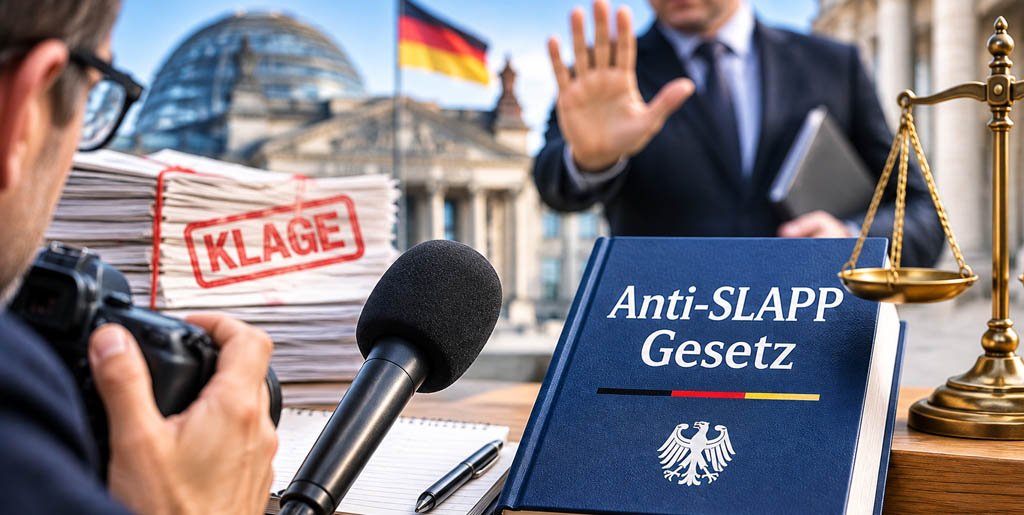

The German government has introduced its bill implementing the EU directive against abusive lawsuits in the Bundestag. The deadline expires on May 7. The key questions and answers.
Explainer
What are SLAPPs? The acronym stands for “strategic lawsuits against public participation.” These are proceedings in which the plaintiff is less interested in winning in court than in silencing critics through cost, time and fear. Those targeted include journalists, academics, environmental groups and activists, often when they investigate companies or politicians with plenty of money and lawyers.
What has the EU decided? Directive (EU) 2024/1069, known as the anti-SLAPP directive, obliges member states to better protect those targeted: with the possibility of dismissing manifestly unfounded lawsuits early, with reimbursement of costs and with sanctions against abusive plaintiffs. It must be implemented by May 7, 2026. It was launched after the 2017 murder of Maltese journalist Daphne Caruana Galizia, who faced more than 40 defamation suits at the time of her death.
What does the German bill provide? The federal cabinet approved the bill on December 10, 2025; the Bundesrat, the chamber representing the states, raised no objections on January 30; it has been before the Bundestag since February 2 (document 21/3942). It adds a new section to the Code of Civil Procedure on abusive proceedings against people who take part in public debate. Courts are to handle such cases as a priority and on an expedited basis, and to be able to require the plaintiff to provide security for legal costs. Defendants are to receive more extensive reimbursement of costs, courts can impose a special court fee on abusive plaintiffs in individual cases, and judgments in such cases are to be published.
What is the catch? The protection applies only to proceedings with cross-border implications, the minimum the directive requires. The Justice Ministry’s first draft of June 2025 had also covered purely domestic cases; after criticism from the German Judges’ Association, among others, the cabinet limited it to a one-to-one implementation. The government argues that purely domestic cases are rare because online publications usually have an effect across borders. A publisher in Munich sued by a company from Augsburg would not be covered. Journalists’ associations and civil society organizations are therefore calling for the protection to be extended to purely domestic German cases, as recommended by the European Commission and the Council of Europe.
Does Germany even have a SLAPP problem? Experts disagree. Lawyers’ associations point out that German courts already dismiss unfounded lawsuits. Support centers, on the other hand, report cases in which the mere threat of an expensive injunction suit is enough to keep a story from being published; the No-SLAPP-Anlaufstelle, a German support center, says it has handled more than 40 cases since May 2024. The problem is hard to measure, precisely because many of those targeted quietly back down.
Why does this matter to readers? An intimidation lawsuit is aimed at a journalist, but it hits the public. Every investigation that is not published out of fear of legal costs is information citizens lack: about environmental damage, corruption, wrongdoing at companies. Small newsrooms and freelance journalists are particularly vulnerable because they lack the money for long proceedings. Effective protection against SLAPPs is therefore protection of every individual’s right to be informed.
Sources
- German Bundestag: document 21/3942 (February 2, 2026)
- DAV: statement on the draft bill (lobby register, August 2025)
- LTO: Anti-SLAPP soll nicht für rein deutsche Fälle kommen (December 10, 2025)
- beck-aktuell: Bundesregierung beschließt mehr Schutz vor Schikane-Klagen (December 10, 2025)
- BMJV: draft bill published (June 20, 2025)
- No-SLAPP alliance: press release (December 17, 2025)
- Directive (EU) 2024/1069 (EUR-Lex)