
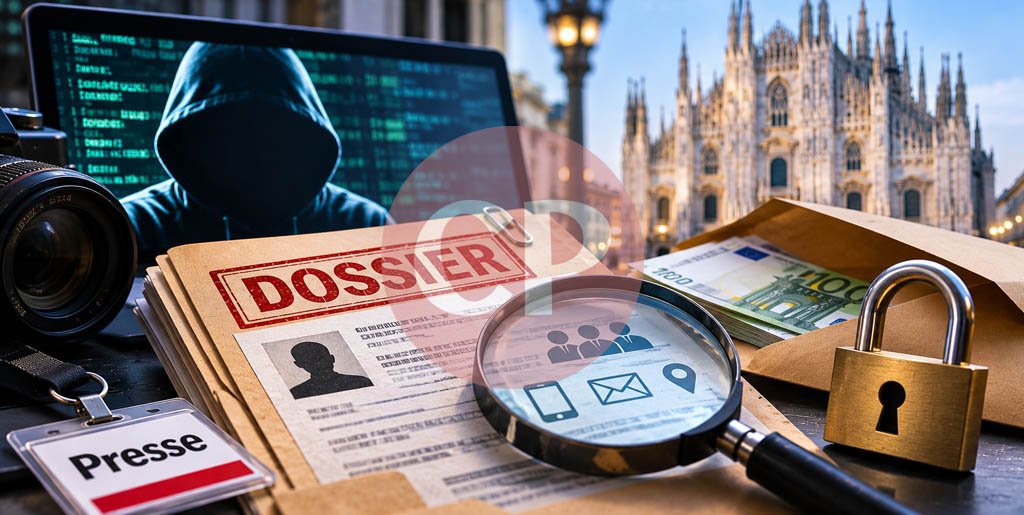

A private investigative agency allegedly tapped into secret state databases for years and sold dossiers on politicians, business leaders and celebrities. The case shows how vulnerable citizens and journalists become when information turns into a commodity.
Analysis
On Saturday, October 26, two of Italy’s most senior investigators stood side by side at the Milan prosecutor’s office: Milan Chief Prosecutor Marcello Viola and national anti-mafia prosecutor Giovanni Melillo. What they presented has gripped the country ever since. There is, Melillo said, a “gigantic market for confidential information.”
What is known
At the center is Equalize srl, an investigations and risk analysis firm based on Via Pattari, a few steps from Milan Cathedral. According to media reports, its majority shareholder, with about 95%, is Enrico Pazzali, president of the Fondazione Fiera Milano, the foundation behind the Milan trade fair. The foundation itself has nothing to do with the case; Pazzali, who is under investigation, has suspended himself from office. Equalize’s managing director is Carmine Gallo, a retired police officer who spent decades with Milan’s criminal police.
The anti-mafia department of the Milan prosecutor’s office and the national anti-mafia directorate list about 60 suspects. Measures have been imposed on six people, four of whom are under house arrest, including Gallo. The charges include criminal association, unauthorized access to protected state databases, bribery, illegal interception of communications and disclosure of official secrets. According to Italian media, the suspects also include well-known names from the business world.
How the system allegedly worked
According to investigators, the suspects accessed SDI, the central database in which police forces record complaints, investigations and criminal records, as well as other state registers, for example on taxes. Access was allegedly gained through bribed officials and technical tools. The data was used to compile dossiers that clients bought: companies wanting to dig into competitors or business partners, or private individuals in disputes.
In the wiretapped conversations, as the news site Open reports, it sounds like this: they could “expose all of Italy.” According to the documents, an email account in the name of President Sergio Mattarella was even allegedly cloned. Prime Minister Giorgia Meloni called the dossiers “intolerable” and said her sister Arianna had been spied on in order to hit at her.
Why this concerns journalists
The case affects journalism on two levels.
First, as a target. Anyone with access to police and tax data can spy on investigations, unmask sources or intimidate reporters. According to the news agency AGI, the name of well-known TV journalist Enrico Mentana also comes up in the suspects’ conversations. Whether and how journalists were spied on is still unclear. But the mere possibility is enough to deter informants. Source protection is worthless if private snoops can buy a reporter’s call records and files.
Second, as a possible buyer. Some of the dossiers probably ended up in business disputes, and some perhaps in newsrooms. There is a line here that journalists must take seriously. A leak in the public interest that exposes wrongdoing and whose authenticity is verified is something different from a bought dossier meant to harm a rival. Anyone who publishes such material without checking its origin and purpose becomes a tool, not a check on power. Italy already knows this debate: since the spring, prosecutors in Perugia have been investigating mass database searches from within the anti-mafia directorate, and there too the question was how information reached journalists.
What it means for each individual
State databases contain citizens’ lives: criminal records, investigations, incomes, addresses. They exist because the state promises to use them only for lawful purposes. If that promise can be bought, everyone loses control over what others know about them. That affects celebrities, but just as much the employee in a legal dispute with an employer.
A free press is doubly important in this setting. It must expose such networks and ask how officials were able to sell data unnoticed for years. And it must set rules for itself so that it does not become a market for illegally obtained information. Without independent media, citizens would be left alone facing two powers: a state that stores too much about them, and a market that turns that data into money.
Open questions
- How long did the system operate, and why was the access not noticed sooner?
- Who were the clients, and what did they use the dossiers for?
- Were journalists or their sources spied on?
- What controls will the Interior and Finance ministries now introduce for the databases?
All suspects are presumed innocent until convicted by a final judgment.
Sources
- Il Post: C’è una grossa inchiesta su una serie di furti dalle più importanti banche dati
- Il Post: Cosa si sa dell’inchiesta (October 27, 2024)
- Open: Tra i 60 indagati anche Del Vecchio Jr e Arpe, Melillo: «mercato gigantesco»
- Open: «Possiamo sputtanare tutta l’Italia»
- AGI: Gli arrestati fanno anche il nome di Mentana
- Milano Finanza: I conti di Equalize
- Il Giorno: Il sistema dei dossieraggi illegali