
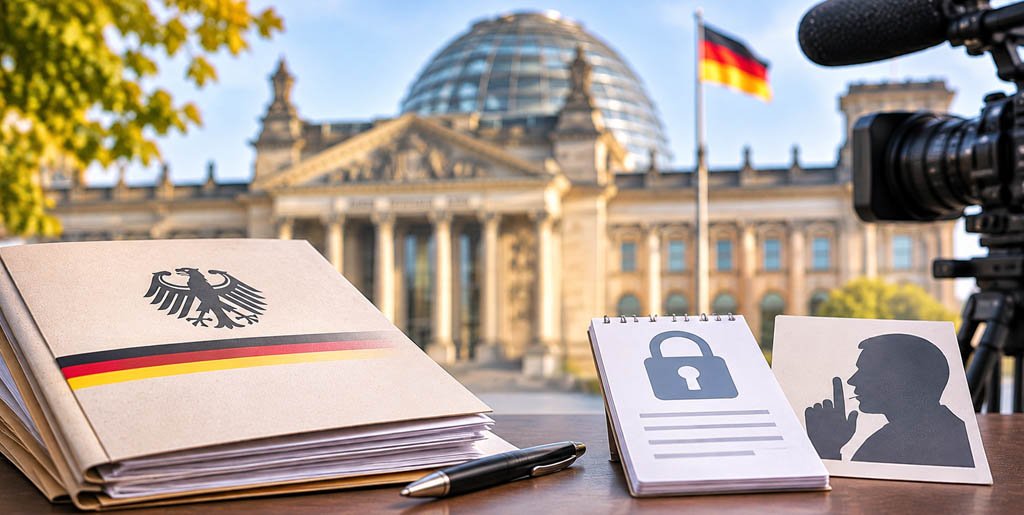

Within two weeks, Germany’s governing coalition has launched two projects that alarm journalists: restrictions on the Freedom of Information Act and a reform of the intelligence services. What is planned, and why it affects every citizen.
The Freedom of Information Act. Since 2006, anyone in Germany has been able to request access to the records of federal authorities without giving a reason. Journalists and organizations have used the law (Informationsfreiheitsgesetz, IFG) to make contracts, expert opinions and agreements public, most recently, for example, in investigating the procurement of face masks during the COVID-19 pandemic. On July 2, the coalition committee of the CDU/CSU and the SPD decided to fundamentally change the law. Under the decision, requests would only be possible with a “legitimate interest,” and only natural persons would be allowed to file them: media companies, associations and other organizations would be excluded. Anyone who is neither a German nor an EU citizen would lose the right to file a request, fees could rise, and the names of government employees would be redacted from records as a rule. The government justifies the reform as reducing the burden on the administration.
Opposition is broad. More than 110 organizations, associations and media outlets, including abgeordnetenwatch, FragDenStaat, the German Journalists’ Association (DJV), Netzwerk Recherche, LobbyControl and Transparency International, are calling in an open letter for the plans to be stopped. The changes would be “a fatal blow to press freedom in Germany,” they write. Arne Semsrott, project lead at FragDenStaat, calls it the most serious attack on government transparency in the history of the Federal Republic. Human Rights Watch has also urged the federal government to drop the plans. Criticism is even coming from within: the Federal Commissioner for Data Protection and Freedom of Information, Louisa Specht-Riemenschneider, and working groups of the SPD’s parliamentary group have come out against the plans.
The intelligence reform. At the same time, the Federal Interior Ministry has presented a draft bill for a fundamental reform of the law governing the intelligence services. The public broadcasters ARD and Deutschlandradio, the publishers’ associations BDZV and MVFP, the journalists’ unions DJV and dju, the private broadcasters’ association Vaunet and the German Press Council called in a joint statement on July 14 for better protection of journalists and their sources.
What this means
Both projects touch the same core: the relationship between the state and the public. The Freedom of Information Act governs what citizens may learn from the state. Intelligence law governs what the state may learn about journalists and their informants. If the first is narrowed and the second widened, the balance shifts in favor of the state.
This does not affect journalists alone. A right to access records without giving a reason is every individual’s right to scrutinize their government, whether they are a retiree, a business owner or a student. Anyone who has to prove why they want to know something becomes a supplicant. And anyone who fears that their message to a newsroom will end up with an intelligence agency will not send it.
In April, Germany fell from 11th to 14th place in the World Press Freedom Index. The federal government should take the criticism as an opportunity: for a modern transparency law that eases the burden on administrations without shutting citizens out, and for source protection that meets the requirements of the European Media Freedom Act.
Sources
- abgeordnetenwatch: Breites Bündnis warnt (July 7, 2026)
- abgeordnetenwatch: Koalition will Informationsfreiheitsgesetz faktisch abschaffen (July 2, 2026)
- netzpolitik.org: Schwarz-Rot plant Frontalangriff auf Journalismus und Transparenz (July 2026)
- netzpolitik.org: SPD-Fraktion gegen De-facto-Abschaffung der Informationsfreiheit (July 8, 2026)
- turi2: Netzwerk Recherche und über 100 Organisationen schreiben offenen Brief (July 7, 2026)
- beck-aktuell: Informationsanfragen künftig nur noch für Privatpersonen? (July 2, 2026)
- beck-aktuell: Über 100 Organisationen protestieren (July 7, 2026)
- Human Rights Watch: Regierung greift Informationsfreiheitsgesetz an (July 8, 2026)
- utopia.de: Das Gesetz, das Spahns Maskenaffäre ans Licht brachte
- DJV, ARD, BDZV, Presserat, Deutschlandradio, dju, MVFP, Vaunet: statement on the draft intelligence law (July 14, 2026)
- turi2: Medienverbände fordern besseren Schutz im Nachrichtendienstrecht (July 15, 2026)
- LTO: Juristische Presseschau, plans to reform the intelligence services (July 15, 2026)